
The Complete Guide to AI Interview Coaching: Prepare Smarter, Interview Better
The Complete Guide to AI Interview Coaching: Prepare Smarter, Interview Better
Job interviews remain one of the most stressful experiences in professional life. According to a JDP survey, 93% of Americans have experienced interview anxiety at some point. Traditional preparation methods — practicing in front of a mirror, rehearsing with friends — offer limited feedback and inconsistent results.
AI interview coaching is changing the game. Using speech recognition, natural language processing, and real-time analytics, AI tools can guide you through every stage of interview preparation with precision and objectivity that human practice partners simply cannot match.

Why Traditional Interview Prep Falls Short
The Information Gap
Candidates rarely know exactly what interviewers are looking for. You can research the company and role, but predicting specific questions, evaluation criteria, and cultural fit expectations remains largely guesswork.
Lack of Honest Feedback
When friends or family help with mock interviews, they tend to be encouraging rather than critical. They might miss that you speak too fast, use too many filler words, or fail to structure your answers clearly. These subtle issues can make or break a real interview.
Limited Practice Opportunities
Real interviews are scarce and high-stakes. Each one is a learning opportunity, but learning exclusively through trial and error means potentially losing out on your dream job while you figure things out.
How AI Interview Coaching Works
Pre-Interview: Strategy Analysis and Preparation
A quality AI interview coach starts working long before the actual interview. TANPAN.AI's pre-meeting strategy analysis feature, for example, can:
- Analyze job descriptions: Automatically parse JD keywords to help you understand what the employer truly values
- Generate likely questions: Predict interview questions based on the role, industry, and company culture
- Suggest answer frameworks: Provide STAR method (Situation, Task, Action, Result) structures for each anticipated question
- Summarize industry trends: Compile the latest industry developments so you can demonstrate domain expertise
During the Interview: Real-Time Transcription and AI Coaching
This is where AI interview coaching becomes truly powerful. During the actual interview:
Real-time speech-to-text ensures nothing is missed. Azure-powered speech recognition accurately captures conversation in multiple languages, creating a complete record of the exchange.
Real-time AI coaching provides discreet prompts during the interview, such as:
- Reminding you to mention a relevant project or achievement
- Suggesting you quantify your claims with specific data
- Gently nudging you back on track when you start to ramble
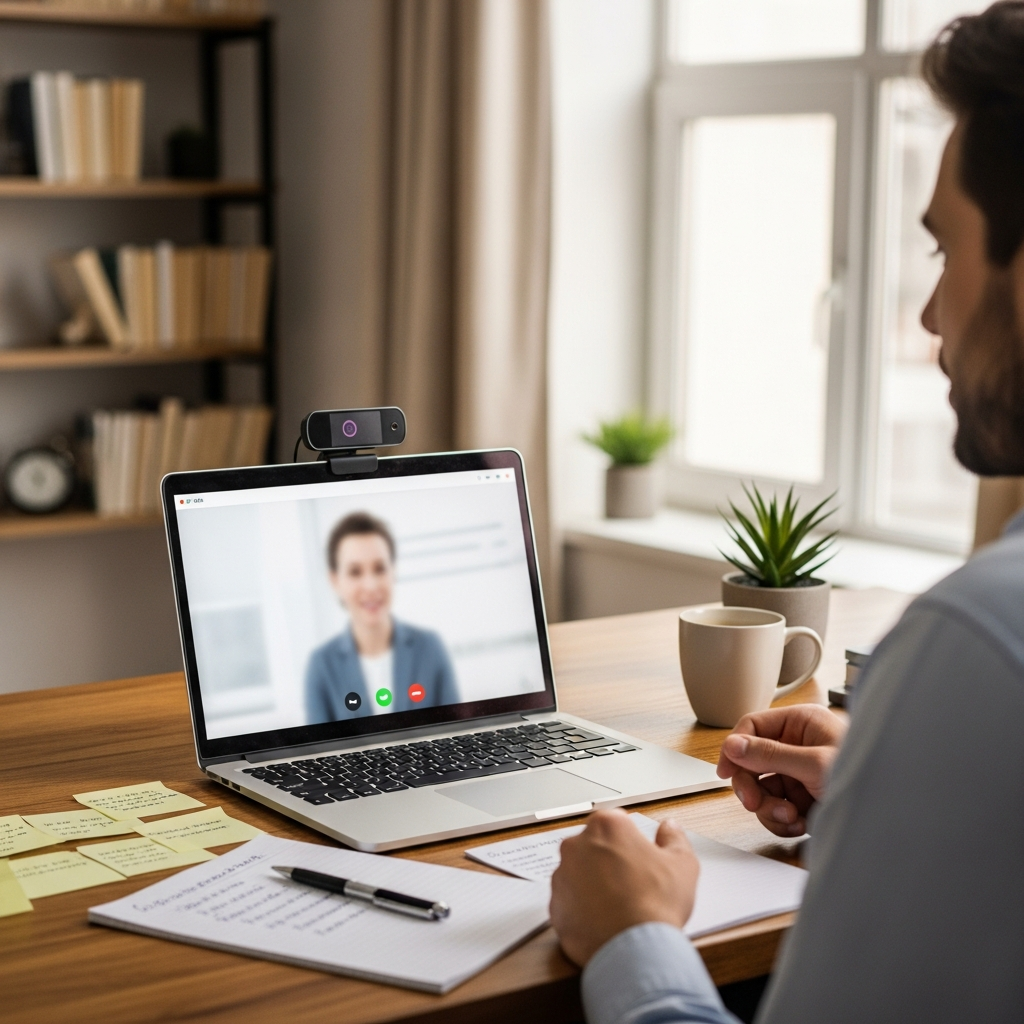
Post-Interview: AI Analysis and Scoring
After the interview, AI generates a comprehensive analysis report covering:
- Content quality: Were your answers relevant, complete, and persuasive?
- Communication style: Speech pace, tone, vocabulary professionalism
- Time management: How long you spent on each question and whether the distribution was balanced
- Improvement recommendations: Specific areas to focus on for next time
How Candidates Can Maximize AI Interview Coaching
Step 1: Build Your Interview Knowledge Base
When starting with an AI interview coach, set up your personal profile:
- Upload your resume and cover letter
- Input the target job description
- List your key projects, achievements, and metrics
- Set your interview goals (target salary range, company preferences, etc.)
Step 2: Practice Through Simulation
Use AI for repeated mock interviews covering different question types:
- Behavioral questions: "Tell me about a time you resolved a conflict at work"
- Situational questions: "How would you handle a project that's falling behind schedule?"
- Technical questions: Role-specific expertise assessments
- Stress interviews: High-pressure scenarios to build resilience
After each simulation, carefully review the AI feedback and focus your practice on identified weaknesses.
Step 3: Analyze Real Interviews
When you go through actual interviews, use the AI coach's recording feature. Afterward, compare the AI analysis with your own perception to identify blind spots.
Step 4: Track Progress Over Time
Maintain an interview tracker documenting:
- AI score trends across sessions
- Most frequently asked question types
- Areas showing the most improvement and those needing more work
For Hiring Managers: Using AI to Improve Interview Quality
AI interview coaching benefits both sides of the table.
Structured Interview Design
AI helps hiring managers create fairer, more effective interview processes:
- Generate standardized question sets based on role requirements
- Establish consistent scoring rubrics
- Reduce the impact of unconscious bias
Real-Time Documentation
Interviewers are often too busy listening and asking follow-up questions to take comprehensive notes. AI speech-to-text captures the complete conversation, freeing interviewers to focus on genuine engagement with candidates.
TANPAN.AI's Interview Mode is designed specifically for this purpose. It can:
- Automatically record the entire interview
- Flag key candidate responses
- Generate structured interview reports
- Support multi-interviewer collaborative scoring
Team-Based Hiring Decisions
Hiring typically involves multiple interviewers. Through AI platform collaboration features, the entire hiring team can:
- Access complete interview transcripts
- Submit individual assessments
- Discuss candidate strengths and weaknesses
- Make more objective and data-driven hiring decisions
Five Practical Interview Preparation Tips
Tip 1: Structure Every Answer with STAR
For behavioral questions, always use the STAR framework:
- Situation: Briefly set the context
- Task: Explain your specific role and objective
- Action: Describe exactly what you did
- Result: Quantify the outcome with specific metrics
AI coaching can evaluate whether each STAR response is complete and which component needs strengthening.
Tip 2: Prepare Three Versions of Your Introduction
- 30-second version: The elevator pitch
- 1-minute version: Standard interview opener
- 3-minute version: Detailed professional background
Tip 3: Research Beyond the Company Website
Go deeper than surface-level company research:
- Read recent news coverage and press releases
- Review interviewer backgrounds on LinkedIn
- Prepare examples that align with the company's stated values
- Understand the competitive landscape
Tip 4: Prepare Thoughtful Questions to Ask
The "Do you have any questions for us?" moment is your chance to demonstrate genuine interest and strategic thinking. Prepare at least five substantive questions about the role, team dynamics, and company direction.
Tip 5: Optimize Your Remote Interview Setup
With many companies conducting initial rounds virtually, your technical setup matters:
- Stable internet connection (wired if possible)
- Clean, professional background
- Good lighting on your face
- Clear audio quality
Navigating Multilingual Interviews
In today's global job market, interviews increasingly happen across languages. Whether you are interviewing at a multinational corporation or applying for a role in another country, language barriers add an extra layer of complexity.
TANPAN.AI's real-time translation supports five languages — Chinese, English, Japanese, Korean, and Thai — providing live language assistance during interviews. Even if your second language skills are still developing, AI translation helps you:
- Confirm you understood the interviewer's question correctly
- Mentally organize your foreign-language response more quickly
- Review the original vs. translated text post-interview to identify language improvement areas
Real Results: AI Interview Coaching in Action
Case Study 1: Career Transition
A marketing professional with seven years of experience wanted to transition into product management at a tech company. Using AI interview coaching over four weeks, they:
- Completed 18 mock interview sessions
- Improved their AI score from 61 to 87
- Successfully received offers from two leading tech firms
Case Study 2: New Graduate
A recent computer science graduate with zero interview experience used AI coaching to:
- Generate 50+ potential interview questions for their target roles
- Prepare structured answers for each question
- Improve speaking pace (identified as too fast) and reduce filler words
- Land an offer by their fourth interview
The Future of AI Interview Coaching
As AI technology continues to advance, interview coaching capabilities will only grow:
- Sentiment analysis: Reading emotional states through vocal tone and word choice
- Personalized learning paths: Automatically designing practice plans based on individual weaknesses
- Industry-specific knowledge: Integrating sector-specific interview trends and common questions
- Cross-platform integration: Seamlessly connecting with calendars, job boards, and ATS systems
TANPAN.AI's Google Calendar integration already provides automatic pre-interview reminders and preparation materials based on your upcoming schedule.
Conclusion
Interview preparation no longer has to be a solitary, hit-or-miss endeavor. AI interview coaching provides 24/7 practice opportunities, objective performance analytics, and continuous improvement tracking. Whether you are a fresh graduate entering the job market or an experienced professional planning your next career move, leveraging AI tools will help you walk into every interview more confident and better prepared.
Frequently Asked Questions
Does AI interview coaching actually work?
Multiple studies show that candidates who use AI interview coaching for mock practice improve their interview pass rates by 30-40% on average. The key advantage is objective, consistent, and detailed feedback that helps you identify issues you would never notice on your own.
Who should use an AI interview coach?
Anyone who interviews can benefit: new graduates, career changers, professionals targeting specific companies, and even hiring managers who want to improve their interview processes. Different roles can use different feature modules.
Is it appropriate to use AI coaching during a real interview?
This depends on the interview format and company policy. Using AI for practice is universally appropriate. For real interviews, check whether the employer permits assistive tools. TANPAN.AI is designed to provide discreet, non-disruptive real-time hints without interfering with the interview flow.
What languages does the AI interview coach support?
TANPAN.AI supports real-time speech-to-text and translation in five languages: Chinese (Traditional and Simplified), English, Japanese, Korean, and Thai — ideal for candidates facing multilingual interviews.
How is an AI interview coach different from a human coach?
AI coaches offer 24/7 availability, location independence, and quantitative performance analytics. Human coaches provide unique value in interpersonal dynamics, emotional support, and industry-specific insights. The best strategy combines both.
What equipment do I need to use an AI interview coach?
All you need is a computer or smartphone with a microphone and internet connection. A quality external microphone is recommended for the best speech recognition accuracy.
Get Started Today
Try TANPAN.AI for free — Sign up and get 50 credits to fully explore all features. No credit card required.