
Breaking Language Barriers: How AI Real-Time Translation Transforms Multilingual Meetings
Breaking Language Barriers: How AI Real-Time Translation Transforms Multilingual Meetings
In a globalized business landscape, cross-border collaboration is the norm. But when a conference room — physical or virtual — brings together colleagues from Taipei, Tokyo, Seoul, Bangkok, and New York, language instantly becomes the biggest obstacle. According to Harvard Business Review, language barriers reduce cross-border team communication efficiency by an average of 40%, and miscommunication-related business losses run into billions of dollars annually.
Traditional solutions — hiring interpreters, using translation headsets, or mandating English for all — each have significant limitations. The maturation of AI real-time translation technology is delivering an unprecedented solution for multilingual meetings.

The Real Business Impact of Language Barriers
Missing Critical Information
When participants speak in a non-native language, subtle nuances are frequently lost. The Japanese phrase "kentou shimasu" (I'll consider it) is often a polite refusal in Japanese business culture, yet non-Japanese speakers may interpret it as a positive response. These cultural-linguistic misreadings are alarmingly common in cross-border negotiations.
Declining Participation
When attendees struggle to follow a foreign language, their cognitive resources are consumed by comprehension rather than critical thinking. Research shows that people attending meetings in a non-native language speak approximately 50% less frequently, and their creative contributions drop even more dramatically.
Degraded Decision Quality
Language barriers do not just slow communication — they directly degrade decision quality. When team members cannot fully express their viewpoints or completely understand others' arguments, decisions are built on incomplete information.
Post-Meeting Execution Gaps
Misunderstandings born from language issues during a meeting often surface only during execution. A misunderstood delivery date or a misinterpreted technical specification can lead to weeks of rework.
How AI Real-Time Translation Works
Speech to Text: Real-Time Speech Recognition
The first step in AI translation is accurate speech recognition. TANPAN.AI uses Azure Speech Services' real-time STT (Speech-to-Text) technology, converting speech to text as words are spoken. Key capabilities include:
- Simultaneous multilingual recognition: The system automatically detects and distinguishes between languages, accurately handling even mid-sentence language switching
- Noise filtering: Background noise, crosstalk, and other meeting-environment interference are effectively managed
- Domain-specific vocabulary: Higher accuracy for specialized terminology in business, technology, finance, and other professional fields
Text to Translation: Real-Time Semantic Conversion
Once speech is transcribed, the AI translation engine converts content into the target language in real time. Unlike traditional word-by-word translation, modern AI translation uses semantic understanding:
- Context awareness: Interprets each sentence within the broader context of the meeting, rather than translating sentences in isolation
- Business register adjustment: Uses appropriate formality levels and professional expressions for formal business settings
- Cultural adaptation: Converts culture-specific expressions from the source language into natural equivalents in the target language
Five-Language Real-Time Translation
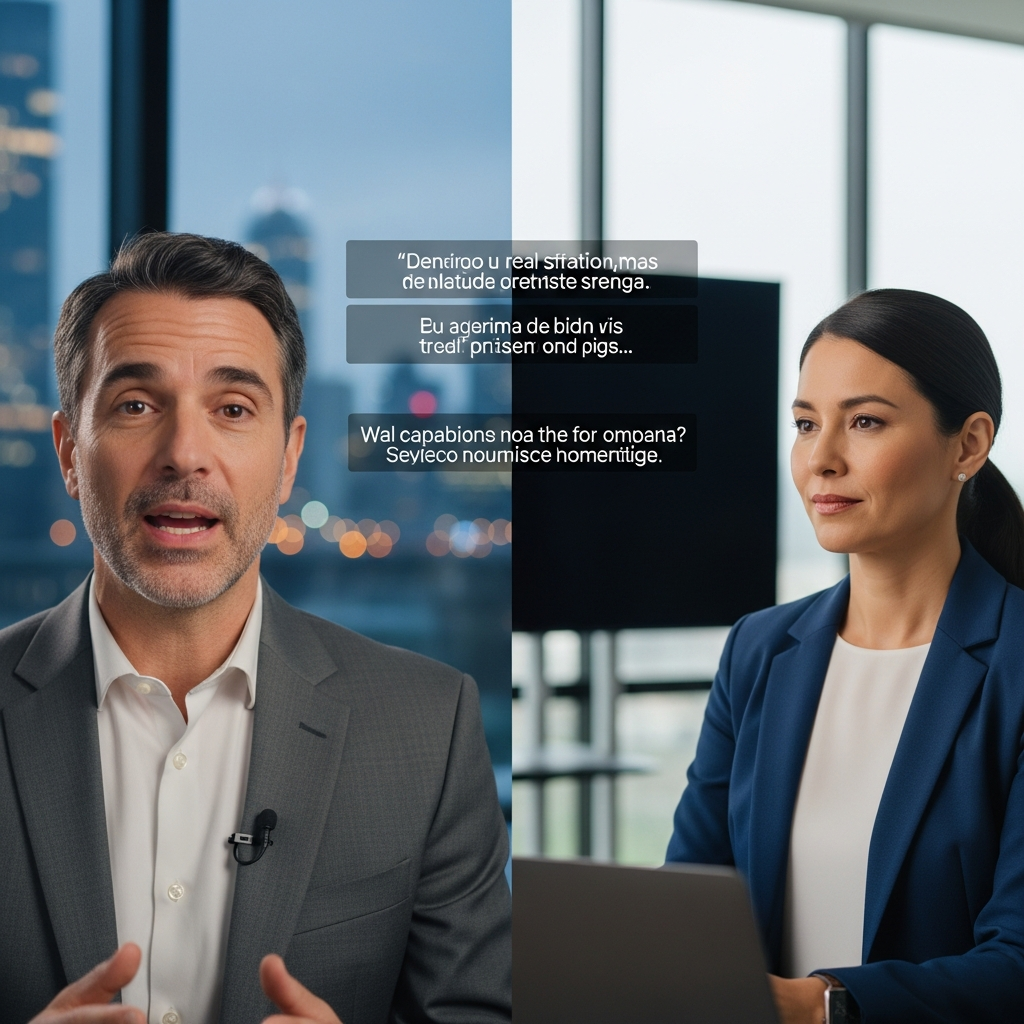
TANPAN.AI currently supports real-time translation across five languages: Chinese, English, Japanese, Korean, and Thai. These five languages cover the most widely used business languages in the Asia-Pacific region, enabling multinational teams to speak in their native tongue while viewing real-time translated subtitles in their preferred language.
Practical Tips for Multilingual Meetings
Before the Meeting
Share Agendas and Key Terminology
Before any cross-border meeting, distribute the agenda and anticipated key terms in multilingual versions. This allows every participant to familiarize themselves with relevant vocabulary in advance, reducing comprehension barriers during the meeting itself.
TANPAN.AI's pre-meeting strategy analysis feature can automatically translate meeting agendas into all five languages and flag specialized terms that may cause comprehension difficulties.
Set Language Preferences
Before starting, confirm each participant's language preference. Some people may prefer reading English subtitles even if it is not their native language. TANPAN.AI allows each participant to independently set their preferred translation target language.
During the Meeting
Speak Slowly and Use Clear Sentence Structures
Even with AI real-time translation, clear expression remains the foundation of smooth communication. Speakers should:
- Maintain a pace of 120 to 150 words per minute
- Avoid long compound sentences — express one idea per sentence
- Minimize slang, puns, and culture-specific metaphors
Use Confirmation Checks
When discussing important topics or making decisions, build a habit of confirming understanding:
- "Let me confirm — you're saying that... Is that correct?"
- "I'd like to rephrase this point to make sure we're all on the same page."
TANPAN.AI's real-time AI coach proactively prompts participants to confirm when it detects potential ambiguity.
Leverage Written Supplements
Spoken and written communication complement each other. When discussing numbers, dates, proper nouns, or other details that are easily mistranslated verbally, type them simultaneously in a chat window or shared screen to ensure accuracy.
After the Meeting
Multilingual Meeting Records
After a traditional cross-border meeting, compiling meeting notes is a nightmare — it requires someone fluent in all languages present to accurately capture every speaker's points.
TANPAN.AI's post-meeting analysis automatically generates multilingual meeting summaries, including:
- Complete transcripts in each language
- Key decisions and action items summarized in all languages
- Each speaker's main arguments organized and attributed
Confirm Action Items
Immediately after the meeting, send action item lists to each owner in their native language. This seemingly simple step dramatically reduces execution gaps caused by language misunderstandings.
Multilingual Meeting Strategies by Scenario
Cross-Border Business Negotiations
In high-stakes negotiations, every word matters. AI real-time translation ensures both parties precisely understand each other's terms and bottom lines, reducing language-driven deadlocks.
International Team Standups
In regular cross-border team meetings, AI translation allows every member to report progress and raise issues in their native language, ensuring no one is sidelined due to language proficiency.
Cross-Border Training Sessions
When companies need to deliver unified training to employees across countries, AI translation ensures all participants fully understand the training content without language-related learning gaps. TANPAN.AI's training mode is specifically optimized for this scenario.
International Customer Service
When serving customers from different countries, AI real-time translation enables support teams to deliver native-language-quality service without staffing dedicated agents for each language.
Key Considerations When Choosing an AI Translation Tool
Translation Latency
The "real-time" aspect of real-time translation is critical. Delays exceeding three seconds noticeably disrupt conversational flow. TANPAN.AI keeps translation latency within one to two seconds, preserving natural conversation rhythm.
Domain Accuracy
The quality gap between general translation and domain-specific translation is substantial. Verify whether the tool can accurately handle terminology specific to your industry.
Integration Capabilities
Can the translation tool integrate with your existing meeting tools and workflows? TANPAN.AI offers Google Calendar integration, automatically enabling translation for scheduled cross-border meetings.
Privacy and Security
Cross-border meeting discussions often involve proprietary information. Verify the AI translation service's data handling policies to ensure your meeting content is not used for unintended purposes.
Frequently Asked Questions
What accuracy can AI real-time translation achieve?
State-of-the-art AI translation achieves 90% to 95% accuracy in general business contexts. Accuracy may be slightly lower for highly specialized technical discussions, but pre-meeting terminology configuration can significantly improve results.
Can AI translation replace human interpreters?
For day-to-day business meetings, AI translation already meets most needs. However, for high-stakes legal negotiations or diplomatic contexts, human interpreters remain essential. The best approach treats AI and human interpretation as complementary, not competitive.
Which languages are currently supported?
TANPAN.AI currently supports real-time translation across five languages: Chinese, English, Japanese, Korean, and Thai — covering the primary business languages of the Asia-Pacific region.
Does network quality affect translation performance?
AI real-time translation requires a stable internet connection. A minimum upload speed of 10 Mbps is recommended, with wired connections preferred for optimal real-time performance and stability.
How does translation perform when multiple people speak simultaneously?
TANPAN.AI's speech recognition system can distinguish between different speakers, but simultaneous speech still reduces recognition accuracy. For best results, multilingual meetings should follow a "one speaker at a time" rule.
Conclusion
Language should never be a barrier to global collaboration. Mature AI real-time translation technology enables team members to express ideas in whatever language feels most natural, while ensuring everyone accurately understands each other's perspectives.
TANPAN.AI's five-language real-time translation, combined with pre-meeting strategy analysis, real-time AI coaching, and post-meeting analysis, delivers a complete multilingual meeting solution for global teams. Whether it is a routine standup or a pivotal business negotiation, language barriers are no longer the obstacle they once were.
Make every cross-border meeting as natural as a conversation in your native language.
Get Started Today
Try TANPAN.AI for free — Sign up and get 50 credits to fully explore all features. No credit card required.